Clear Aligners vs. Braces: An Adult Decision Guide
A clinical breakdown of Invisalign, ClearCorrect, Spark, in-office vs. mail-order aligners, and modern braces — so you choose the right option for your case.
⚠️ For educational purposes only
We are not dentists and do not provide dental or medical advice. This article is for general information only — always consult a licensed dentist for diagnosis, treatment, and personalized recommendations.
Adult orthodontics has exploded over the last decade. In 2007, fewer than 20% of orthodontic patients were adults — today nearly 1 in 3 are. The biggest driver: clear aligners. But the choices are dizzying, the marketing is aggressive, and the price gaps are enormous. This guide cuts through the noise, comparing every major option against actual clinical evidence so you can make a confident decision for your case.
How Orthodontic Tooth Movement Actually Works
Whether you wear braces, aligners, or rubber bands, every orthodontic appliance does the same thing: applies sustained, light force to a tooth. That force triggers cells called osteoclasts to dissolve bone on one side of the root and osteoblasts to lay down new bone on the other side — physically migrating the tooth through the jaw. The process is biological, not mechanical: teeth move at roughly 1 mm per month regardless of appliance, and forcing them faster causes root resorption and pain.
Option 1: Traditional & Modern Braces
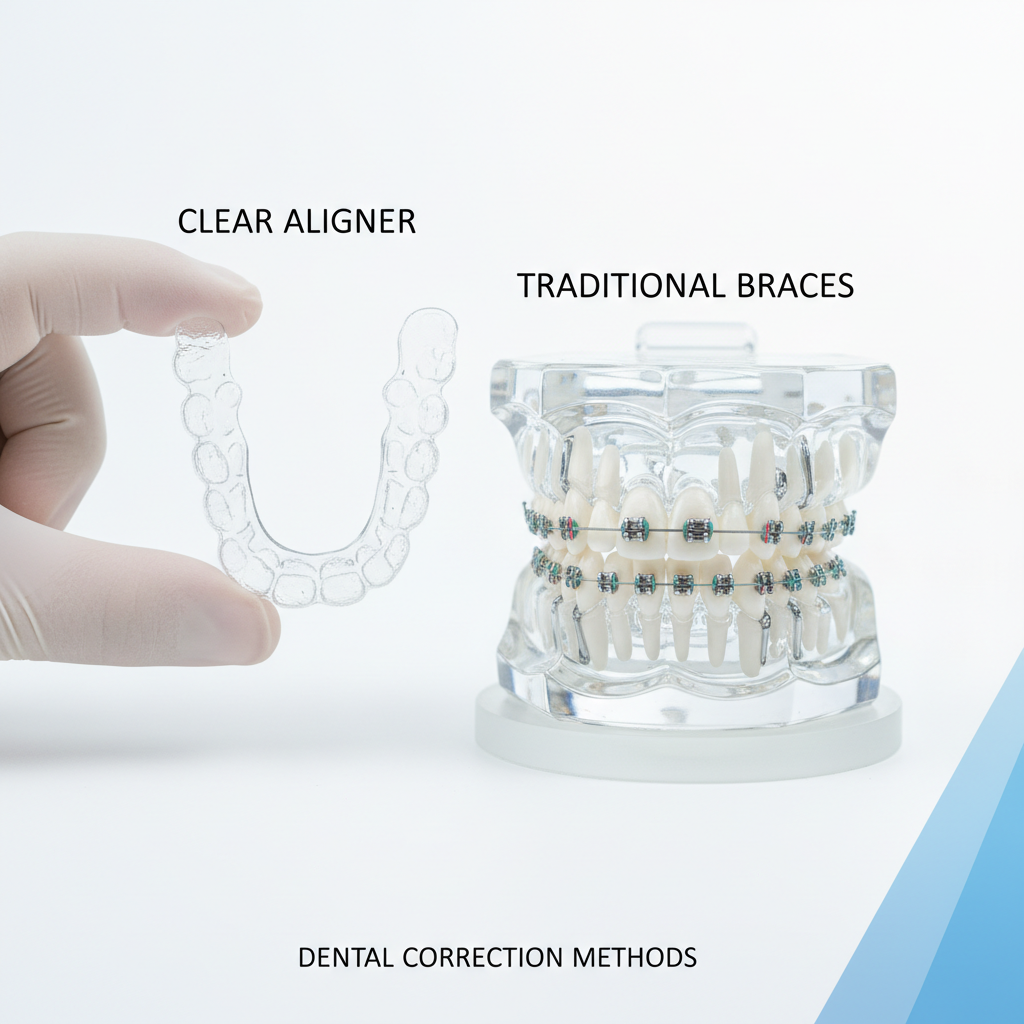
Fixed braces — brackets bonded to teeth and connected by an archwire — remain the most precise and powerful orthodontic system. They can correct virtually any malocclusion and stay on 24/7, eliminating compliance as a variable. Modern braces are smaller, smoother, and more comfortable than the braces of even 10 years ago.
Bracket Types Compared
| Type | Visibility | Speed | Cost premium |
|---|---|---|---|
| Metal (stainless steel) | Most visible | Standard | Baseline |
| Ceramic (clear/white) | Less visible | Standard | +$500–$1,500 |
| Self-ligating (Damon, In-Ovation) | Standard or ceramic | Slightly faster, fewer visits | +$500–$1,500 |
| Lingual (behind teeth) | Invisible from front | Standard | +$2,000–$5,000 |
When Braces Outperform Aligners
Severe rotations (especially of round teeth like canines and premolars), large vertical movements (extruding or intruding teeth), closing extraction spaces, complex bite corrections, and patients with a history of poor compliance. Board-certified orthodontists report that for the most complex 20–25% of cases, fixed braces produce more predictable results than aligners.
Option 2: In-Office Clear Aligners (Invisalign, ClearCorrect, Spark)
These are aligners prescribed and supervised by a licensed orthodontist or general dentist with orthodontic training. The doctor takes records, plans the case, attaches small tooth-colored "attachments" when needed for grip, and supervises progress every 6–10 weeks. This is the only category endorsed by the American Association of Orthodontists for comprehensive treatment.
| Brand | Owner | Strengths | Notes |
|---|---|---|---|
| Invisalign | Align Technology | Largest case database, most predictable software | Industry standard since 1999 |
| ClearCorrect | Straumann | Lower lab fees → lower patient cost | Trim line covers more tooth, slightly tighter fit |
| Spark | Ormco | Clearer material, less staining | Strong for complex cases, more orthodontist-only |
| Angel Aligners | Angelalign | Very competitive pricing | Newer to US market |
| In-house lab aligners | Practice-specific | Lowest cost, doctor-controlled | Quality varies — ask about workflow |
What You Actually Get with In-Office Aligners
Option 3: At-Home / Mail-Order Aligners (Byte, Candid, AlignerCo, NewSmile)
These companies skip the in-person doctor visit. You take an impression at home or visit a scanning center, a dentist remotely reviews your case, and aligners ship to your door. SmileDirectClub — the original DTC aligner company — went bankrupt in late 2023, leaving many patients mid-treatment without support. The remaining brands operate similar models with varying levels of clinical oversight.
What Mail-Order Skips
- •Lower upfront cost ($1,200–$2,400)
- •No in-person visits needed
- •Faster start (no scheduling)
- •Convenient for very mild cases
- •No X-rays — gum disease, root issues, and bone health invisible
- •No physical exam — cavities and infection go undetected
- •No supervising doctor when teeth go off-track
- •No attachments (limits movement types)
- •No IPR (limits crowding correction)
- •Refinements often cost extra
- •No recourse if treatment fails or company folds
Who Should NEVER Use Mail-Order Aligners
Anyone with active gum disease, untreated cavities, missing teeth, prior orthodontic relapse, bite problems (overbite, underbite, crossbite, open bite), TMJ symptoms, or rotated/severely crowded teeth. If you have any restorations (crowns, bridges, veneers), aligners may not bond attachments properly. A simple way to check: if a board-certified orthodontist would say "you need this addressed first" — mail-order skips that step entirely.
True Cost Comparison (Including Hidden Fees)
Quoted prices are often missing components. Use the "all-in" column when comparing.
| Procedure / Option | Low | High | Avg |
|---|---|---|---|
| Mail-order aligners (mild cases only) | $1,200 | $2,400 | $1,900 |
| In-office Invisalign Express (≤7 trays, mild) | $2,500 | $4,500 | $3,500 |
| In-office Invisalign Lite (≤14 trays, mild–moderate) | $3,500 | $5,500 | $4,500 |
| In-office Invisalign Comprehensive (any case) | $4,500 | $8,500 | $6,000 |
| Metal braces (comprehensive) | $3,000 | $7,000 | $5,000 |
| Ceramic braces | $4,000 | $8,000 | $5,800 |
| Lingual braces (Incognito, custom) | $8,000 | $13,000 | $10,500 |
| Retainers (set, after treatment) | $200 | $800 | $450 |
U.S. national average ranges (without insurance), based on the ADA Health Policy Institute Survey of Dental Fees, FAIR Health Consumer, and CareCredit cost guides. Actual prices vary by region, provider, and case complexity — typically by 30–70%. Use these figures as a benchmark, then compare local quotes.
The 22-Hour Rule (and Why Most People Fail It)
Aligners only work when worn 20–22 hours per day. That means you take them out only to eat, drink anything but water, brush, and floss. Studies show the average adult patient self-reports 22 hours but actual wear (measured with embedded sensors) averages 16–17 hours — which is why "Invisalign isn't working for me" is usually a compliance issue, not a system issue. If you eat 4 meals + 2 snack/drink breaks daily, you're already at 19 hours; one missed re-insertion drops you to 17.
- •Removable for special events (with caution)
- •Eat anything
- •Easier brushing/flossing
- •No metal in mouth
- •Compliance entirely on you
- •Speech adjustment for 1–2 weeks
- •Constant re-insertion after meals
- •Aligners must be cleaned after every meal
- •Lost or cracked aligners stall progress
Which Option Fits Your Case?
| Your situation | Recommended option | Why |
|---|---|---|
| Mild crowding/spacing, healthy mouth, very compliant | In-office Invisalign Lite or Express | Fastest, lowest in-office cost |
| Mild front tooth relapse from prior braces | In-office aligners or limited retainer aligners | Targeted, predictable |
| Moderate crowding + good compliance | Comprehensive Invisalign / ClearCorrect | Modern aligners handle this well with attachments |
| Severe crowding requiring extractions | Braces (often by an orthodontist) | Faster and more predictable space closure |
| Significant bite correction needed | Braces or aligner+elastics with orthodontist | Bite correction requires expertise and often elastics |
| Teen patient | Invisalign Teen or braces | Compliance varies — orthodontist will advise |
| Limited budget, very mild case | In-office over mail-order | Skipping diagnosis is high-risk false economy |
| Crowns/veneers/bridges in front | In-office only | Attachments + restorations require expertise |
Orthodontist vs. General Dentist Providing Aligners
Both can legally offer aligners. The difference is training. Orthodontists complete 2–3 years of full-time residency after dental school focused exclusively on tooth movement, biomechanics, growth, and bite. General dentists typically complete weekend courses (often sponsored by aligner companies). For mild cases, both can deliver good results. For moderate-to-complex cases, an orthodontist's training pays off significantly.
The Retainer Phase: Don't Underestimate It
Teeth will relapse without retainers. Period. The first 6 months after treatment are highest-risk; after that, slow lifelong drift continues. Most adult patients should plan to wear retainers nightly forever — much like wearing a mouthguard. Retainers cost $200–$500 to replace; treatment relapse costs $3,000–$8,000 to redo.
| Retainer type | Pros | Cons | Lifespan |
|---|---|---|---|
| Vivera (Invisalign clear) | Comfortable, hard to see | Can crack, not adjustable | 1–2 years per set |
| Essix (clear thermoplastic) | Affordable, quick to make | Wears down faster | 1–2 years |
| Hawley (acrylic + wire) | Adjustable, durable | Visible front wire | 5–10+ years |
| Bonded lingual wire | Permanent, no compliance | Hard to clean, can break | 5–10 years |
Frequently Asked Questions
About the author
Independent dental-content editorial team
Our editorial team researches, drafts, and fact-checks every article against peer-reviewed dental literature and primary government sources (NIH, CDC, NIDCR, ADA). We do not employ practicing dentists, and we never let any office pay to influence editorial content or rankings — see our editorial standards.
Sources & References
This article is based on guidance from accredited dental and health organizations:
- American Association of Orthodontists (AAO) — Consumer Awareness — Direct-to-Consumer Orthodontics
- American Dental Association (ADA) — Statement on Direct-to-Consumer Dentistry
- American Journal of Orthodontics & Dentofacial Orthopedics — Clinical Outcomes of Clear Aligner Therapy
- Cochrane Oral Health — Orthodontic Treatment Systematic Reviews
- World Federation of Orthodontists (WFO) — Guidelines on Remote Orthodontic Care
- American Board of Orthodontics (ABO) — Board-Certified Orthodontist Resources
Last reviewed: May 2026
Medical disclaimer: This content is for educational purposes only and is not a substitute for professional dental advice, diagnosis, or treatment. Always consult a licensed dentist for personalized guidance about your oral health.
Get the top dental deals in your city — every Wednesday
5 verified deals + 1 cost guide. Free. You'll get your first deals instantly.